Experiments and evidenceCitation measurement
Aug 12, 20269 min read
The Control Group Playbook for AI Citation Content Tests
Your before-and-after citation chart proves nothing without a pre-registered control group. Here is the protocol.
Read guideEdenRank editorial
Source-aware operating guides for teams measuring AI answers, inspecting citations, and deciding what to improve next.
Latest guide
Your before-and-after citation chart proves nothing without a pre-registered control group. Here is the protocol.
Updated Aug 12, 2026 / 9 min read / Experiments and evidence / Citation measurement
Browse by the problem you are working on: visibility strategy, citations, site clarity, buyer questions, and trust signals.
Definitions, denominators, audits, and reporting that keep mentions and citations separate.
Explore cluster02Source graphs, earned placements, editorial outreach, and exact citation paths.
Explore cluster03Crawlers, rendering, indexing, schema, logs, and machine-readable delivery.
Explore cluster04Entity disambiguation, authorship, product facts, and corroborating trust signals.
Explore cluster05Answer assets, comparisons, references, and evidence-gated editorial production.
Explore cluster06Observable differences between engines, answer surfaces, and retrieval paths.
Explore cluster07Controlled tests, evidence classes, causal limits, and reproducible proof.
Explore cluster08Asset-path attribution from visit to signup and confirmed first-paid.
Explore cluster09Vertical-specific workflows for SaaS, agencies, ecommerce, and services.
Explore clusterYour before-and-after citation chart proves nothing without a pre-registered control group. Here is the protocol.
Read guide
Give every product claim an owner, source, timestamp, validation rule, and explicit unknown state before an agent reads it.
Read guide
Do not force AI visibility and revenue into one score. Use two ledgers, preserve every denominator, and join them only when the account-level path is complete.
Read guide
Use FAQPage markup only when the page already shows the question and the answer. Treat any extraction or citation effect as an untested hypothesis, and design a controlled observation before you rely on it.
Read guide
Google AI Overviews doesn't cite your page; it cites isolated answer blocks your page provides.
Read guide
Compare owned citation work, advertising, sponsored placements, provider-run costs, disclosure duties, and the evidence each channel can support.
Read guide
Define Answer Engine Optimization for B2B, separate it from SEO, and run a documented citation audit without inventing ranking mechanisms.
Read guide
Map SaaS pricing questions to inspectable pages, official product facts, fixed prompt tests, and separate citation, visit, and signup measures.
Read guide
Compare GEO and traditional SEO by workflow, evidence, denominator, and reporting boundary without treating AI citations as ordinary rankings.
Read guide
Structure conversational answers around one buyer decision, visible evidence, addressable sections, fixed prompts, and exact source receipts.
Read guide
Schema tuned only for Google's star ratings and FAQ dropdowns can still leave an AI engine unable to tell who you are. Here is the schema that actually resolves entity identity.
Read guide
A citation increase after a page change is an observed change. Call it causal lift only when assignment, controls, timing, and frozen evidence support that claim.
Read guide
Do not start with a list of places to post. Start with the URLs answer engines already cite, classify their ownership and role, then choose the next reachable source lane.
Read guide
sameAs is an identity assertion, not a link directory. Keep only URLs that represent the exact same organization or person and can be independently verified.
Read guide
robots.txt is a published crawl preference, not an authentication or security boundary. Configure explicit groups, test real URLs, and verify behavior in logs.
Read guide
A six-phase operating playbook for turning ecommerce product questions into owned, testable assets with an explicit validation and rerun log.
Read guide
A complete source-mapping workflow with a downloadable CSV, worked rows, a routing matrix, delivery receipts, and a controlled refresh protocol.
Read guide
A practical workbook for comparing AI citation observations without cherry-picking runs or claiming unsupported causes.
Read guide
A reproducible measurement protocol with separate denominators, a worked dataset, calculator, and downloadable files for citation rate, source share, and prompt coverage.
Read guide
Compare AI visibility monitoring costs, run volume, evidence exports, and exclusions before choosing a plan or approving a vendor quote.
Read guide
Package AI visibility reporting with fixed prompt panels, citation denominators, evidence receipts, client-ready caveats, and transparent pricing.
Read guide
Prioritize low-cost citation work using existing pages, source receipts, fixed prompts, and bounded reruns instead of unsupported volume claims.
Read guide
Build product comparison pages with visible evidence, valid Product markup, review disclosures, fixed prompts, and exact source-URL tracking.
Read guide
Measure public-web and tenant-grounded Copilot separately using Bing AI Performance, Microsoft connectors, exact sources, and dated receipts.
Read guide
AI engines don't cite the most popular page - they cite the most structurally legible one. Here's what that means for B2B content.
Read guide
Map positioning claims to recommendation prompts, supporting evidence, target pages, exclusions, and a preregistered measurement schedule.
Read guide
Audit server logs for documented AI user agents, distinguish crawler identities from product tokens, and preserve recheckable request evidence.
Read guide
Turn buyer questions into bounded content clusters with one decision per page, explicit evidence, internal links, and fixed citation tests.
Read guide
Audit citation readiness using visible claims, valid markup, source receipts, crawl controls, fixed prompts, and provider-specific evidence.
Read guide

Evaluate AI visibility software by provider coverage, stored answers, exact sources, failure handling, exports, pricing, and denominator rules.
Read guide
Build a measurable topical cluster with explicit scope, useful internal links, primary evidence, exact target URLs, and scheduled reruns.
Read guide
Write for Google AI Overviews using ordinary Search eligibility, visible evidence, clear sections, fixed tests, and exact source inspection.
Read guide
Define a competitor citation gap, map the cited source and buyer decision, publish a distinct evidence asset, and verify the exact target URL.
Read guide
GSC hides AI Overview data inside aggregate metrics. Here is the monitoring workflow that surfaces your actual citation footprint.
Read guide
Use review data with valid Review markup, FTC-compliant collection, dated platform evidence, frozen prompts, and separate outcome measures.
Read guide
AI citation isn't random - it mirrors SEO signals you already control. Here's how to make both ChatGPT and Perplexity pick your page.
Read guide
Most interview answers fail because they dump features instead of proving source judgment. This briefing shows the five signals growth teams actually score and the answer shape they trust.
Read guide
Most teams treat llms.txt as a minor config file, but it's actually a curated communication channel that can significantly boost AI citations.
Read guide
Most brands are invisible in ChatGPT not because of poor content, but because they fail the three filters ChatGPT uses to cite sources. Here's how to pass all three in 30 days.
Read guide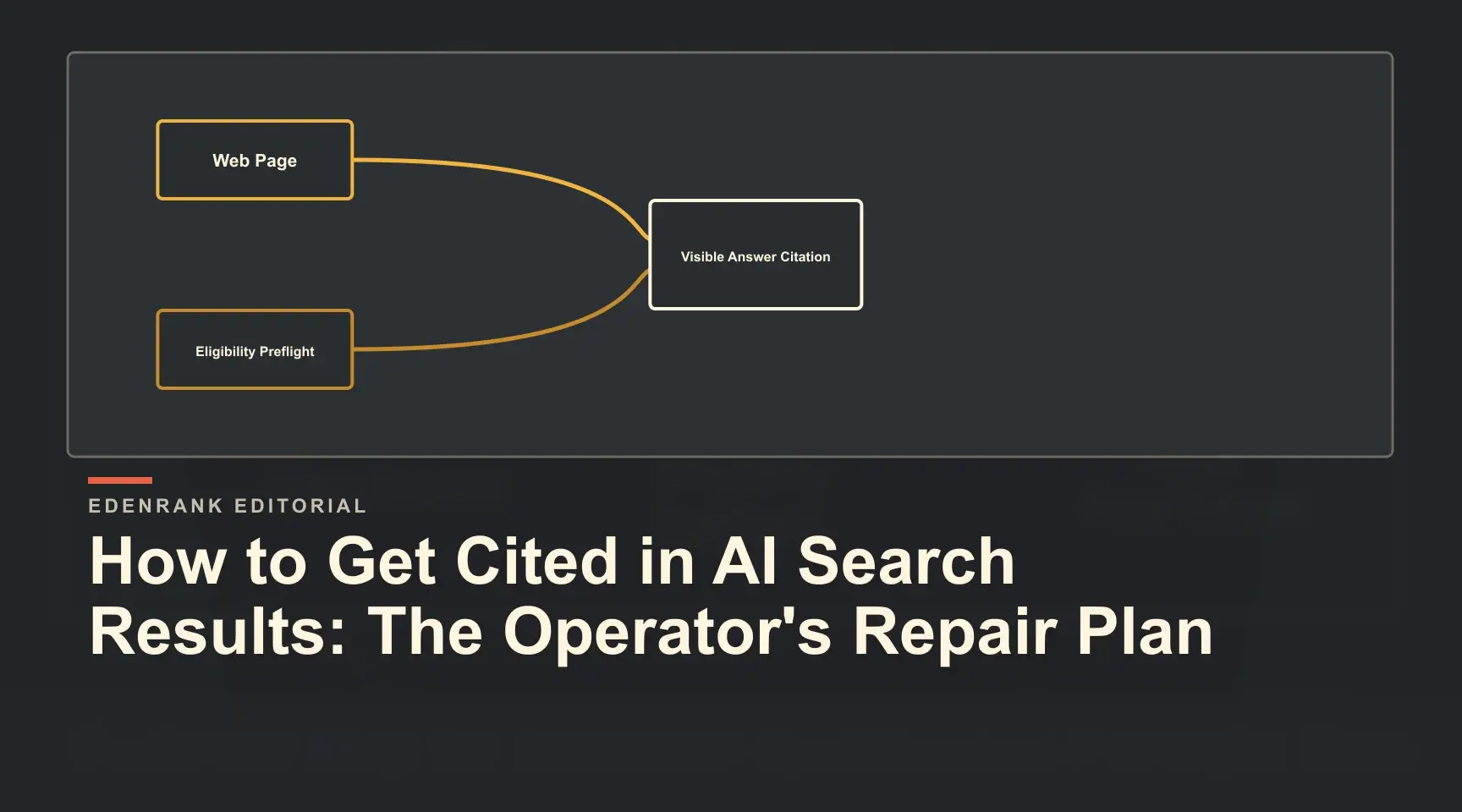
A fail-closed repair plan for finding the real citation bottleneck, changing one thing, and measuring the exact result.
Read guidePage 7 of 7
Most interview answers fail because they dump features instead of proving source judgment. This briefing shows the five signals growth teams actually score and the answer shape they trust.
Proof line
Treat Perplexity as a synthesis and source-checking layer, not a ranking substitute.
Most teams treat llms.txt as a minor config file, but it's actually a curated communication channel that can significantly boost AI citations.
Proof line
Treat llms.txt as a strategic B2A communication channel, not a technical checkbox.
Most brands are invisible in ChatGPT not because of poor content, but because they fail the three filters ChatGPT uses to cite sources. Here's how to pass all three in 30 days.
Proof line
The fastest fix is to rewrite key product and FAQ pages in Plain English, using clear definitions and no fluff.
A fail-closed repair plan for finding the real citation bottleneck, changing one thing, and measuring the exact result.
Proof line
There is no setting that guarantees an AI citation; this workflow prevents spending on the wrong failure stage and makes each intervention falsifiable.